Fume Extraction System and Its Synergy with Welding Ventilation Solutions
Fume Extraction System serves as the core infrastructure for controlling welding fume in industrial settings, especially when integrated with multiple welding stations. When combined with a central filter cartridge dust collector, a Fume Extraction System forms a centralized solution that captures, filters, and treats welding fumes uniformly across the workspace. This setup eliminates the need for individual extraction units at each station, reducing equipment redundancy while ensuring consistent air quality. Unlike standalone devices, a centralized Fume Extraction System leverages a network of ducts and hoses to channel fumes from all welding points to a single filtration hub, making it highly efficient for facilities with high-volume welding operations. Its compact design—owing to the centralization of filters and fans—saves valuable floor space, aligning with modern workshop layout principles that prioritize functionality and organization.
Fume Extraction System works in tandem with a Welding Ventilation System to create a comprehensive air management framework
A Welding Ventilation System focuses on maintaining overall airflow in the welding area, preventing the stagnation of fumes that might escape localized extraction. While the Fume Extraction System targets fumes at the source, the Welding Ventilation System supplements this by diluting any remaining contaminants and directing fresh air into the workspace. This synergy is crucial in large factories where welding stations are spread out; the Welding Ventilation System ensures that even if fumes temporarily disperse, they are quickly moved toward the Fume Extraction System’s ductwork. Additionally, the Welding Ventilation System can be adjusted to match the airflow requirements of the Fume Extraction System, optimizing energy usage and avoiding unnecessary air turbulence that could disrupt welding precision.
Fume Extraction System often integrates with a Welding Exhaust System to enhance the removal of treated fumes from the facility
A Welding Exhaust System is responsible for expelling filtered air—after it passes through the Fume Extraction System’s central filters—outside the building or recirculating it back (if meet air quality standards). This step is vital to prevent recontamination; without a reliable Welding Exhaust System, filtered fumes might linger near the workspace, negating the Fume Extraction System’s efforts. In outdoor or semi-enclosed welding sites, the Welding Exhaust System works with the Fume Extraction System to push fumes away from workers, using directional vents that align with wind patterns to maximize dispersion. For indoor facilities, the Welding Exhaust System ensures compliance with local air emission regulations, as it controls the release of any residual particles that might remain after filtration.
Fume Extraction System complements the functionality of a Welding Smoke Collector, especially in centralized setups
A Welding Smoke Collector is typically designed to capture fumes at individual stations, but when connected to a Fume Extraction System, it acts as a "pre-collector" that initializes fume capture before the central system takes over. This layered approach improves efficiency: the Welding Smoke Collector traps larger particulate matter first, reducing the load on the Fume Extraction System’s central filter cartridge. In facilities where some welding stations handle high-heat, high-fume processes (such as MIG or TIG welding), the Welding Smoke Collector’s heat-resistant components protect the Fume Extraction System’s ductwork from damage, extending the overall system’s lifespan. This collaboration also allows for flexible maintenance—individual Welding Smoke Collectors can be serviced without shutting down the entire Fume Extraction System.
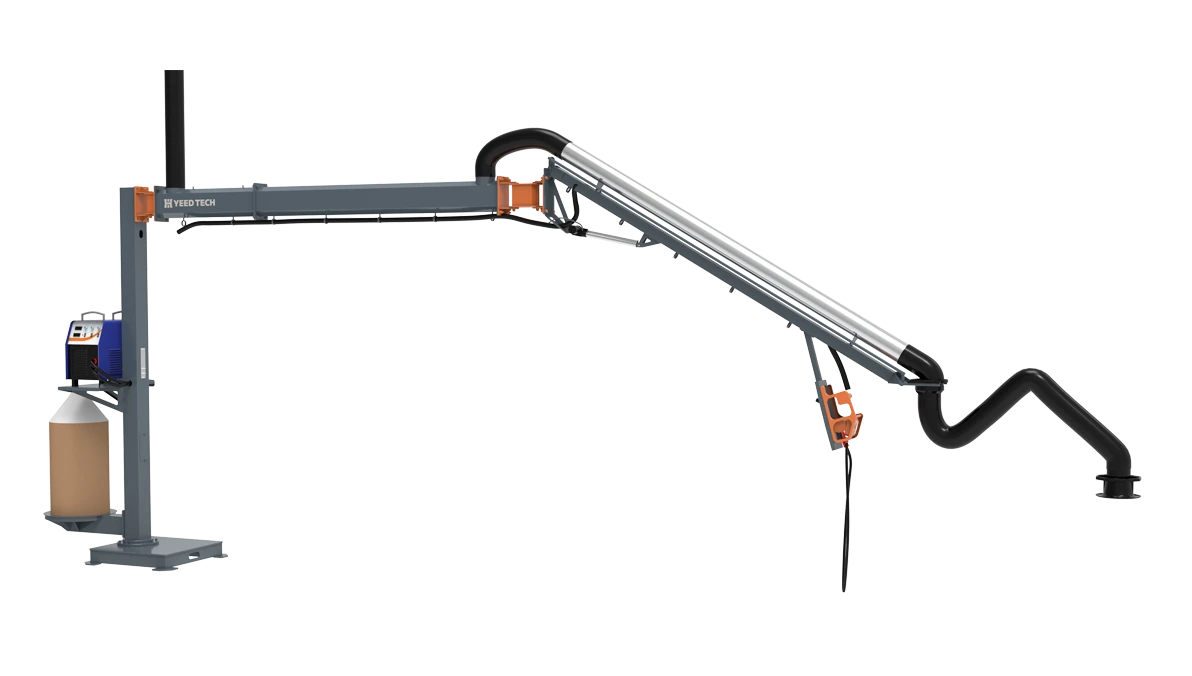
Fume Extraction System relies on a Welding Arm to optimize source capture of welding fumes
A Welding Arm is a flexible, adjustable component that attaches to the Fume Extraction System’s duct network, allowing workers to position the extraction nozzle directly above or near the welding arc. Its articulated design enables 360-degree movement, adapting to different welding angles and workpiece sizes—from small components to large structural parts. In a centralized Fume Extraction System, each welding station is equipped with a dedicated Welding Arm, ensuring that fumes are captured at the point of generation before they can disperse. The Welding Arm’s lightweight yet durable construction makes it easy to maneuver without hindering the welder’s movements, balancing functionality with user comfort. Some advanced Welding Arms also feature adjustable airflow controls, syncing with the Fume Extraction System’s central fan to match the volume of fumes produced by different welding processes.
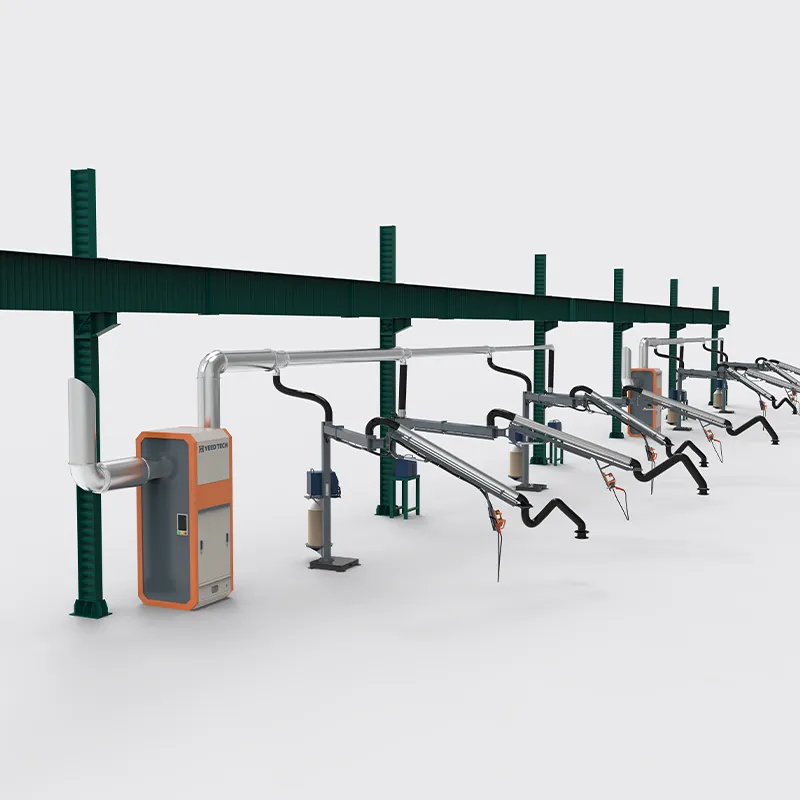
In summary, Fume Extraction System is the backbone of effective welding fume management, working in harmony with Welding Ventilation System, Welding Exhaust System, Welding Smoke Collector, and Welding Arm to create a safe, efficient workspace. When paired with a central filter cartridge dust collector, it offers a space-saving, high-performance solution for multiple welding stations, capturing and treating fumes uniformly. The Welding Ventilation System ensures overall airflow, the Welding Exhaust System manages filtered air release, the Welding Smoke Collector aids in pre-filtration, and the Welding Arm optimizes source capture—all contributing to the Fume Extraction System’s effectiveness. This integrated approach not only protects workers from harmful fumes but also ensures compliance with regulations and supports smooth, productive welding operations. As industrial welding scales up, the role of Fume Extraction System and its supporting components will remain essential, adapting to evolving needs to maintain clean and safe work environments.
Fume Extraction System FAQs
1. What is a fume extraction system designed for?
A fume extraction system is specifically engineered to capture, filter, and remove hazardous airborne contaminants generated during industrial processes like welding, soldering, or chemical handling. It protects worker health and improves air quality by effectively removing fine particulate matter and fumes directly at the source.
2. How does a centralized fume extraction system work with multiple welding stations?
A centralized fume extraction system uses a network of ducting to connect multiple welding stations to a single, powerful filtration unit. The contaminated air is captured at each source through extraction arms or hoods, transported through the ducts, and finally purified by a central filter cartridge dust collector before being recirculated or safely exhausted outside.
3. What are the key advantages of a modern fume extraction system?
Modern fume extraction systems offer significant benefits including a compact footprint, high energy efficiency, and superior filtration performance. They are designed for centralized collection, which simplifies maintenance, reduces operational noise at the workstations, and provides a comprehensive solution for managing low-concentration emissions across a large facility.
4. Why is a filter cartridge dust collector a critical component in a fume extraction system?
The filter cartridge dust collector is the core purification component in a fume extraction system. It utilizes high-efficiency filter cartridges to trap extremely fine particulate matter from the airstream. This design ensures high filtration efficiency, low maintenance requirements, and is exceptionally effective for handling the fine fumes and dust typical in welding applications.
5. What types of emissions can a fume extraction system effectively purify?
A fume extraction system is highly effective at purifying particulate matter, including fine dust, smoke, and metallic fumes generated from processes like welding and grinding. It is also the preferred solution for treating low concentration emissions from various industrial applications, ensuring compliance with air quality standards and providing a safer working environment.
Latest News
-
Efficient automated hot air drying equipment for steel structure application
NewsApr.16,2026 -
Efficient hot air drying system for steel structure spraying line
NewsApr.09,2026 -
Optimizing Steel Structure Spraying with Hot Air Drying Technology Solutions
NewsApr.07,2026 -
HighEfficiency Hot Air Drying Painting Equipment for Superior Industrial Coatings
NewsApr.04,2026 -
Optimizing Industrial Processes with Hot Air Furnace Heating Spraying Systems
NewsMar.31,2026 -
Comprehensive Tailormade Steel Structure Spraying Solution for Enhanced Durability
NewsMar.28,2026 -
Optimizing Steel Structure Protection through Customization and Integration of Spraying System
NewsMar.26,2026